Solutions
Dental Practice Management Software for UK Practices
Strengthen the system you have or build the one you need
Blue Tea builds and strengthens dental practice management software for UK practices and the vendors behind them. Projects typically run from £15,000 to £150,000, start with a fixed-price discovery sprint from £750, and are delivered by a UK-based team working under ISO 27001 and ISO 9001 certification.


What we do for dental practices
Most practices come to us in one of two situations. Either the system running the practice is slowing everyone down and the vendor’s roadmap is not going to fix it, or the practice has outgrown off-the-shelf software and the workarounds are multiplying: spreadsheets beside the diary, double entry between systems, reports assembled by hand at month end.

In practice this means one of three things:
 Strengthening the platform you already runConnecting systems that do not talk to each otherBuilding custom where off-the-shelf stops
Scheduling and diary management, patient records and notes, permissions, recalls, reporting. Where the fastest route is working inside your existing platform, that is what we do, the way we did with Pixadent, rather than forcing a rip-and-replace. Where systems do not integrate, we build the layer that joins your practice software, your imaging, your patient communications and your accounts, so data moves without anyone retyping it.
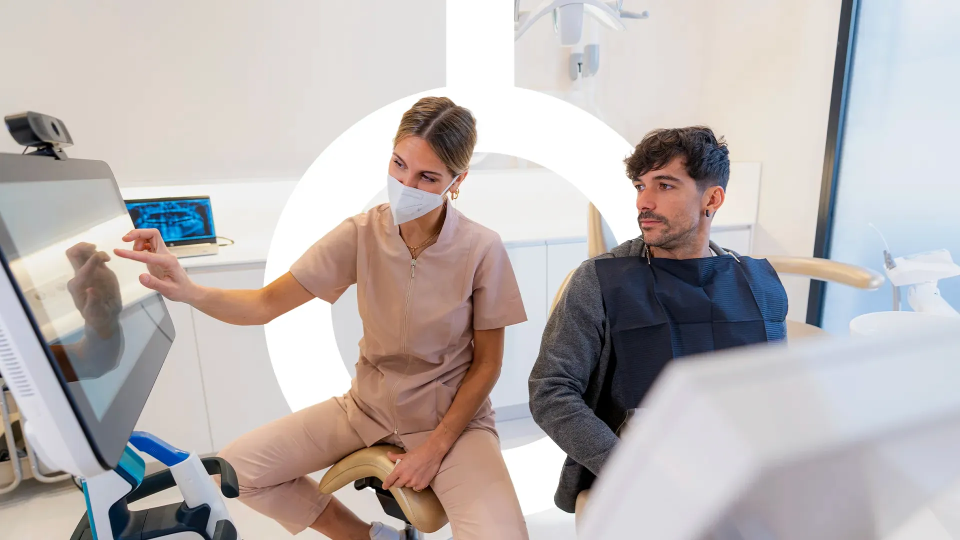
Adding AI where it does actual work:
Clinical transcription drafted into structured notesDocument classification and data extractionRecall, triage and no-show prediction from your own dataNot a chatbot bolted onto a website. Anything touching patient data is designed around GDPR and NHS compliance from the first sketch to the final result because in dentistry that is not optional.
What dental software development actually costs
Most agencies will not publish this, and neither will most dental software vendors. We will, because the first question every practice principal asks is what it costs, and being made to book a call to find out is a poor start to a relationship.

Discovery Sprint: From £750
Two weeks. We map how the practice actually runs, where the current system fights the workflow, and what to fix or build first. You receive a scoping document you can take to any provider, including ones that are not us.

AI Workflow Audit: £1,500 to £2,500 fixed
Two days. The three highest-value automation opportunities in your practice workflow, prioritised by return, with an implementation roadmap. No commitment to build.

MVP Build: £15,000 to £40,000 fixed
Fixed scope, three to five core features, eight to sixteen weeks. A patient portal, a reporting suite, a referral management module. You own all the code.

Full Platform: £40,000 to £150,000
A complete practice platform with integrations, multi-user permissions, reporting and a support agreement. Four to nine months.

AI Integration: £10,000 to £60,000
Adding transcription, classification, prediction or automation to the practice system you already run.

Support and Evolution: £500 to £3,000 per month
Ongoing maintenance, hosting, minor enhancements and version updates, priced monthly.
Three things worth knowing about these numbers.

Budget fifteen to twenty percent of the build cost per year for maintenance, hosting and updates. Any provider who does not raise this before you sign is not doing you a favour.

Compliance work costs money and almost nobody prices it.
Patient records are special category data under GDPR. Security review, penetration testing and often a data protection impact assessment are part of the job, and we price them as a visible line rather than discovering them in month four.

Fixed price is available and we prefer it.
It requires the discovery sprint first, because nobody can fix a price on a problem they have not scoped. That is the entire reason the sprint exists.
Built around UK dental compliance, not adapted to it
Much of the practice software on the UK market started life somewhere else. The NHS layer, where it exists at all, is an adaptation: UDA tracking bolted on, FP17 claims handled through workarounds, mixed NHS and private billing reconciled in spreadsheets.
What we build for UK practices accounts for the rules from the start.


NHS contract work
UDA and UOA tracking against contract targets, FP17 claim workflows, and the month-end reporting a practice manager actually reconciles.

Regulatory records
Audit trails and retention aligned to CQC registration requirements and GDC record-keeping standards. Clinical records kept for at least eleven years, and for children to age twenty-five where that is longer.

Mixed and plan income
NHS, private and plan patients, including Denplan and DPAS, in one reconcilable view rather than three.
Our Proof: Turret Orthodontics and the Pixadent platform

The clearest example is published on this site. Turret Orthodontics, a UK group of orthodontic practices, runs on Pixadent, a practice management platform owned by AMK Developments. Blue Tea was brought in to strengthen the platform rather than replace it.
In a first three-month engagement we removed the performance bottlenecks behind slow page loads, introduced drag-and-drop appointment rescheduling, clinician diary zoning and full-day blocking, and streamlined clinician onboarding. A second phase added a three-tier permission structure separating clinical, operational and financial access, a restructured notes system, and a reporting framework covering financial performance and diary utilisation. All of it was delivered while the practices kept seeing patients.
The next phase is already in prototype: AI-assisted clinical transcription that turns secure audio into structured draft clinical notes inside Pixadent workflows, designed around GDPR and NHS compliance. Elsewhere in our published healthcare work: a facilities compliance platform for AirisQ and a secure clinical research application for the University of Surrey. Read the full Turret Orthodontics case study.
We are rated 4.8 on Clutch, where our clients have reviewed us directly.




Security & Compliance


Blue Tea holds ISO 9001:2015 for quality management and ISO 27001:2013 for information security, certified by Citation ISO Certification Ltd.
For a dental practice this is rarely a background detail. You hold medical histories, clinical imaging and payment data for thousands of patients, the CQC can ask how it is protected, and your patients assume it is. We build to those standards by default rather than retrofitting them when an inspection looms, and we can support security review, penetration testing and data protection impact assessments as a scoped, priced part of the project.
Who we work with
We work with practices, and with the companies that build for them:
 Orthodontic and specialist groupsMulti-site general practicesPractices mixing NHS, private and plan workDental software vendors and platform ownersDental service organisations and labs
Sometimes the right client is not the practice but the platform. Pixadent is a vendor’s product; our job was to give it senior engineering capacity without disrupting the practices running on it. If you own a dental software product and need that kind of help, it is a conversation we know well.
We work UK-wide from our offices at Fairoaks Airport in Chobham, Surrey and in Bristol, and we come to you. For a discovery sprint we expect to spend time in the practice, watching how the front desk, the surgeries and the admin team actually use the system, because that is where the requirements live.
FAQ

How much does dental practice management software cost in the UK?
Off-the-shelf platforms are typically subscription priced, and a smaller practice can expect to pay a few hundred pounds a month before add-ons. Custom work is different: strengthening an existing platform or adding AI typically runs £10,000 to £60,000, a fixed-scope build £15,000 to £40,000, and a complete platform £40,000 to £150,000. Every custom project starts with a fixed-price Discovery Sprint from £750 so the estimate is based on scoped requirements rather than guesswork.
Should we replace our practice management system or improve it?
If the core system works and the problems are speed, missing features or clunky workflows, strengthening it is usually faster and cheaper than replacing it, and nobody has to migrate patient records. That was the Turret Orthodontics decision: targeted development on the existing Pixadent platform rather than a rip-and-replace. Replacement earns its cost when the platform is unsupported, unsafe or structurally unable to do what the practice needs.
Can you work with the software we already use?
Usually, yes. We integrate with practice systems, imaging, patient communication tools and accounting software wherever there is an API or a vendor willing to cooperate, and we build the connecting layer when there is not. Where we need to work inside the platform itself, we do that with the vendor’s involvement, as we do with Pixadent.
How do you handle NHS requirements like UDAs and FP17 claims?
We build NHS contract tracking and claim workflows into the system rather than around it: UDA and UOA activity against contract targets, FP17 submission workflows, and reporting that reconciles NHS, private and plan income in one place. Requirements are confirmed against current NHSBSA guidance during discovery, because the rules move.
How do you keep patient data secure and GDPR compliant?
Blue Tea is certified to ISO 27001:2013 for information security and ISO 9001:2015 for quality management. Patient records are special category data, so encryption, role-based access and audit trails are defaults, retention follows NHS records guidance of at least eleven years for clinical records, and a data protection impact assessment is a priced, scoped part of the project where one is needed.
Who owns the code and the intellectual property?
You do, in full. All source code and intellectual property transfer on completion. We write custom code rather than reselling a white-labelled platform, so there is no licensing arrangement that keeps you tied to us.
How long does a dental software project take?
The Discovery Sprint takes two weeks. A fixed-scope build typically takes eight to sixteen weeks from the end of discovery, and a complete platform four to nine months. Strengthening work on an existing platform is often phased, the first Turret Orthodontics engagement ran three months, so the practice sees improvements while later phases are still being built.
Can AI safely be used in a dental practice?
Yes, in the right places and with the right controls. The work we are prototyping for Pixadent turns secure audio into structured draft clinical notes that a clinician reviews before anything enters the record, designed around GDPR and NHS compliance. The pattern to avoid is AI that writes to the clinical record without human review, and we do not build that.
How to start
The first step is a Discovery Sprint: two weeks, fixed price from £750, ending with a scoping document, a technology recommendation and a realistic estimate. You own the output. If you take it to another developer, that is a legitimate outcome and we would rather you did that than commit to a build nobody has properly scoped.
If you are earlier than that and want to know whether AI could take work off your team, the two-day AI Workflow Audit from £1,500 is the smaller first step.
Call 0800 024 6979 or email [email protected].